
If you’ve ever noticed a tingling or slightly numb sensation in your middle finger after scrolling on your phone, you’re not imagining things.
Most people assume it’s a hand issue. Some immediately worry about Carpal Tunnel Syndrome. Others ignore it, hoping it will just go away.
But what if the signal isn’t coming from your hand at all?
At Movement Chiropractic, we often see that the middle finger isn’t the problem—it’s just the messenger. The real issue might be hiding in your neck.
A Moment You Might Recognize
Picture this: You’ve been on your phone for a while—replying to messages, scrolling social media, or checking emails.
Your head slowly drops forward.
Your neck feels stiff.
Your shoulders tighten.
Then quietly, almost subtly, your middle finger starts to tingle. It’s not a sharp pain, but it feels “off”—like your body is trying to get your attention. This is incredibly common among office workers, students, and anyone glued to a screen.
The Anatomy: The C7 Connection
Your neck doesn’t just support your head; it also protects the nerves that travel from your spine down into your arms and fingers.
When you hold your head forward for long periods (a posture often called “Text Neck”), two things happen:
The mechanical load on your neck muscles increases significantly.
The spinal joints and discs at the base of the neck (specifically C6 and C7) are placed under prolonged stress.
Why the middle finger specifically? Nerves exiting the neck supply specific areas of the hand. The nerve root most associated with sensation in the middle finger is C7. When this nerve is irritated by poor posture, the symptom skips the neck entirely and shows up in the finger.
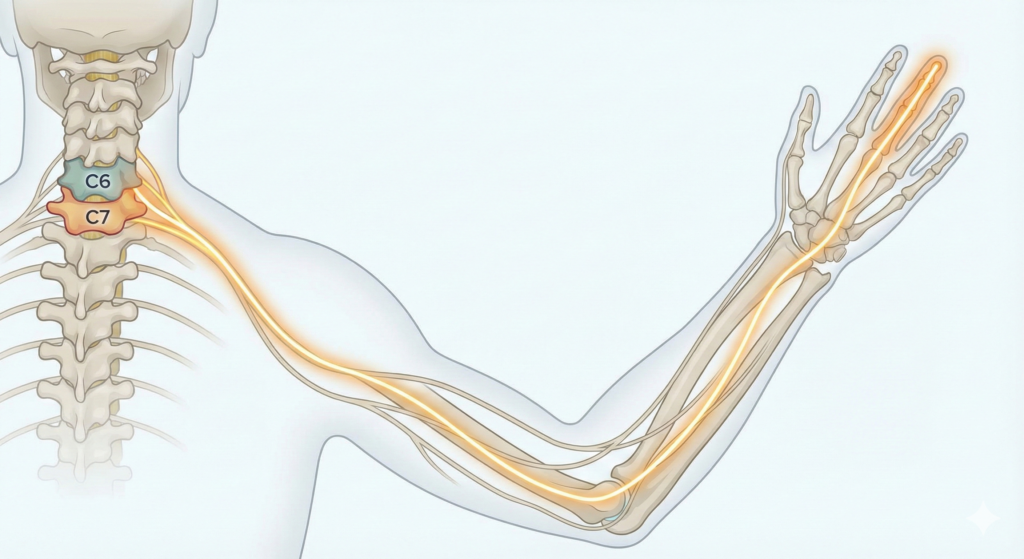
The "Self-Check": Is it Carpal Tunnel or Your Neck?
Understanding the difference matters, because wearing a wrist brace won’t fix a neck problem. Here is a quick guide to help you tell the difference:
It is likely a Wrist Issue (e.g., Carpal Tunnel) if:
The tingling involves the thumb, index, and middle fingers together.
It hurts or tingles when you tap on your inner wrist.
The symptoms are strongly linked to how your wrist is bent (e.g., typing).
It often wakes you up at night.
It is likely a Neck Issue (Cervical Radiculopathy) if:
The tingling is isolated mostly to the middle finger.
It comes with neck stiffness or shoulder tightness.
It changes or improves when you move your neck or correct your posture.
It appears specifically after looking down at a phone or laptop.
Simple Fixes You Can Start Today

You don’t need to overhaul your life to stop the tingling. Small, consistent changes can calm the nerve down.
1. The “Eye Level” Rule When using your phone, bring the screen up to eye level rather than dropping your head down to your lap. Keep your ears roughly aligned over your shoulders.
2. Build in “Micro-Breaks” Nerves hate static pressure. Every 15 minutes, take a 10-second break. Gently pull your chin back (give yourself a “double chin”) to reset your neck to a neutral position.
3. Watch Your Sleep Posture Avoid scrolling in bed with your neck propped forward on high pillows. This sustains the flexion posture that irritates the nerve.
The Movement Chiropractic Perspective
At our clinic, we don’t see symptoms as isolated problems to be silenced. We see them as conversations within the body.
Tingling is not your body “failing.” It is your body asking for space, movement, and relief from sustained strain. In this case, your finger is simply echoing what your neck has been holding onto for too long.
When movement is restored to the spine and pressure is reduced, the body often remembers how to settle on its own—without force, fear, or over-treatment.
Final Thought
If your middle finger tingles, don’t just ask, “What’s wrong with my hand?”
Ask instead: “What position has my neck been living in?”